











Sound Quality: Claims Without Data Are Only an Opinion
Empirically Evaluating Sound.
by Mark Graham, Symetrix Owner & CEO
When I first joined Symetrix, I quickly got on the road and set out to meet with integrators and consultants to gain first-hand experience in how they viewed Symetrix’s strengths and weaknesses.
I knew before I joined that Symetrix had an excellent reputation for sound quality but was surprised by how consistent that positive feedback was. One early meeting summed up the feedback nicely. The principal of a respected integrator with national reach described how his team had run an experiment to compare the sonic performance of Symetrix with three other leading signal processing brands. “Everyone said they were VERY impressed with the sound of the Symetrix. The stereo separation and sound field were markedly better (with Symetrix Radius) than the other brands. Based on this, you may want to ask all your dealers to arrange shootouts, including Symetrix!”
Well, here we are about four years later, and I am back out on the road in the New York area. Over dinner with a consultant friend, the conversation eventually came around to sound quality and he said (to paraphrase): “I tend to believe your claim of higher sound quality, but how do you substantiate it?”
That’s a good question.
Sound quality has been a key component of just about every brand and product I have been a part of over the last 30 years. The natural, and perhaps obvious, questions of what makes one audio product sound better than another, and how can you prove it, have been constants for my entire career. So, after that dinner with my consultant friend, I headed back down some personally well-trodden paths to a spec sheet comparison of Symetrix to those published by a variety of competitors. I was looking, not optimistically, to see if I could find in the spec sheets why Symetrix sounds better and wins shootouts. Not surprisingly, Symetrix audio specifications did not appear, on a published specification level, to have the highest-performance. Arguably, the best specified performance was from a successful brand that is well known for marginal audio quality.
The topic of how audio specifications are published, and why they are unreliable in terms of predicting audio reproduction fidelity is something to address…at some point. But, what’s on my mind today is exploring what makes for high-performance audio reproduction.
To unpack this, let’s go under the hood of a Symetrix digital signal processor and break down the elements of a high-performance processing system.
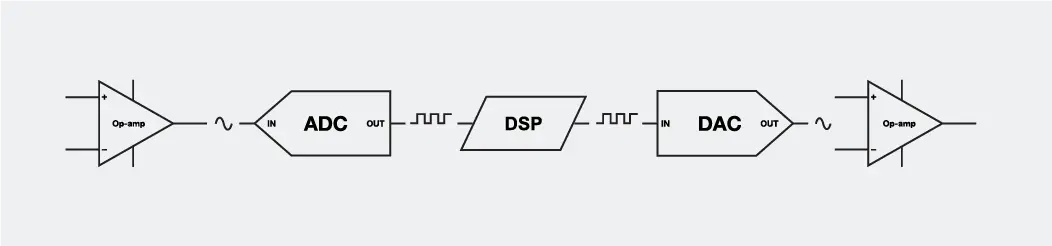
Input Preamplifier → Analog to Digital Converter → Digital Signal Processing → Digital to Analog Converter → Output Preamplifier
To begin, here’s a simple example: we all know that the quality or fidelity of an audio reproduction system is constrained by the weakest link in the signal path. No one would suggest to their customers that they should invest in the highest performance signal processors, amplifiers, and loudspeakers, only then to deploy a commodity mixer as the front-end. It’s well understood that such a system would sound only as good as the commodity mixer. The lowest-performance element (mixer) in the signal path constrains the system-level performance to be no greater than what it can deliver. This principle also determines the highest level of performance that a digital signal processing system can achieve.
Symetrix achieves high-performance through optimizing (sustained over a 45+ year history) the entire signal path. This optimization includes refining the operation of each stage in the signal path as well as the interaction between each element in the signal path. Let’s break down these key components.
Input/output Preamplifier
Symetrix preamplifiers are carefully designed to deliver very low noise and distortion and, high dynamic range, without compromising frequency and phase response. Incredibly wide bandwidth and fast slew rate are also aspects our engineers obsess over for this stage. Collectively, these characteristics provide for a highly accurate audio signal path.
| Low Noise: -134.8 dBu (1 nV/√Hz) EIN @ 60 dB gain. Low THD+N: 0.0003% @ 3-to-30 dB gain; 0.0005% @ 40 dB gain. Wide Bandwidth: 2.7 MHz @ 40 dB gain High Slew Rate: 53 V/μs. |
While these specs may seem overkill, in all signal chains, overall quality is constrained by the lowest performing element. Symetrix delivers the best sound by focusing on every component in the circuit.
ADC/DAC
Analog to Digital Converters (ADC) and Digital to Analog Converters (DAC) are often treated as a simple plug-in component and given only minimal thought by the designer. As with all aspects of the DSP signal path, Symetrix meticulously optimizes the interaction between the converters and the stages delivering or accepting their input and output. This includes a focus on clock jitter, input/output impedance, gain structure, circuit board layout, and more. These efforts deliver superior signal to noise, dynamic range, and accuracy.
Digital Signal Processing
signal processing is performed on Analog Devices Sharc processors.* Although Sharc processors are commonly chosen by most brands, Symetrix implementation is far from common.
Symetrix foregos any off-the-shelf operating systems and designs all Sharc functionality “bare metal.” This refers to programming the Sharc without an operating system to enable its function at the highest possible performance levels without compromise of system efficiency or quality. The end result of this deep optimization is increased signal integrity (accuracy), lower processing-induced noise, and faster response times. Think of a production automobile’s engine performance as compared to one that has had its engine control module (computer) replaced with
one that tunes the engine operation for racing.
Once the signal processing engine has been built and tuned, the actual processing modules (programming blocks containing the math to perform signal modification) are the next link in the chain that must be optimized. True to Symetrix’s design values, these are not simple cookbook modules. Symetrix 400-plus audio processing modules are individually mathematically modeled to accurately emulate high-performance analog studio and broadcast signal processors.
The net result of this highly tuned processing system (engine + hand-crafted processing modules) is audibly superior sound quality.
*A significant competitor has deployed their processing on the Intel x86 general-purpose processor. While this processor enables some excellent features to be realized in firmware, it trades off as a compromise certain aspects of audio signal processing quality and therefore not addressed in these specific comments.
Symetrix’s unblemished shoot-out win record for audio performance is not hard to understand when you lift the hood and get beyond the marketing spin that dominates much of the published audio specifications we see. However, we say in Symlandia, “If you do not have data to back up what you’re saying, it’s just an opinion.” Or, that philosophy’s corollary, “If you can’t explain it and measure it, it’s not real.” So, let’s go to the lab.
Measuring Signal Processor Audio Performance
Question: Why do you think that THD+N and Crosstalk are generally specified at 1 kHz?
It turns out, not surprisingly, that if you take a deeper look at THD+N, at frequencies other than 1 kHz, you get much different results. In our lab, when analyzing signal processor performance, we measure THD+N across the full audio spectrum. This gives us much greater insight as to how signal processors perform, particularly at higher frequencies, where we see the performance of marginal designs deteriorate.
But we can’t stop at full-spectrum THD+N. This measurement provides clues, but not a complete answer in our pursuit of characterizing what makes a signal processor sound better.
From that point, we leap off into a deep dive of the detailed harmonic distortion signatures and output voltage rise times of the signal processors under test. The THD signature test consists of comparing the Fast Fourier Transform (FFT) of the signal processors outputs, at various frequencies across the audio spectrum. The input is a sine wave,
and the FFT of the output delivers this in the frequency domain for analysis–breaking the signal down into its individual frequency components (which theoretically should consist only of the sine wave fundamental, but as we all know real-world electronics create additional frequency components = noise and distortion).
This allows us to see and measure the harmonic artifacts being created by the signal processors, and compare these results across devices. A meaningful difference in audio performance now begins to come into focus.
Under these test conditions, we observe the afore mentioned competitor’s flagship product, when compared to a Symetrix Radius NX delivers these results (see Figure 1):
Internal FFT measurements of a 1 kHz input tone clearly show that Symetrix Radius has slightly more pleasant-sounding even harmonics at 2 kHz, 4 kHz, etc., and significantly less harsh-sounding odd harmonics at 3 kHz, 5 kHz, etc., compared to the competition’s device.
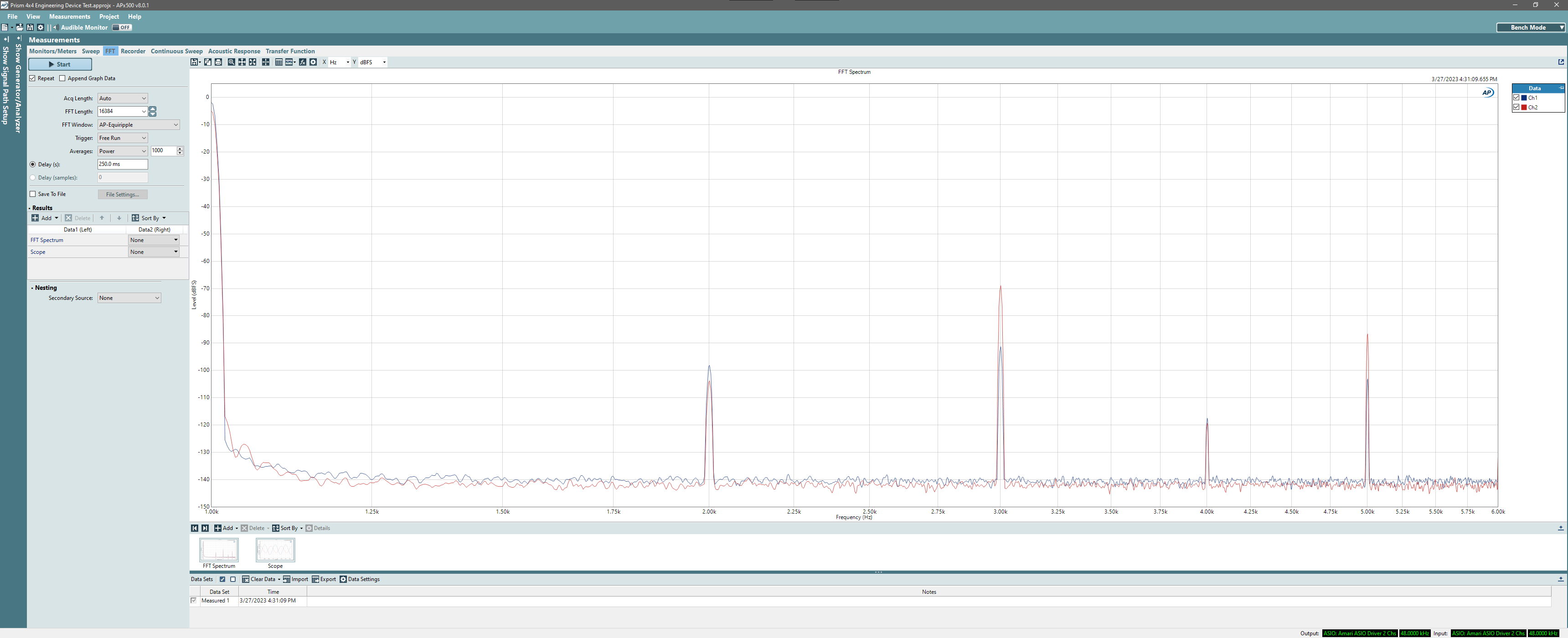
Figure 1. FFT Comparison of Symetrix Radius NX and Competitor’s device THD. A/B comparison of output FFT @ 1 kHz sine wave @ 1 dB below clipping: Blue Line = Symetrix Radius. Red Line = Competitor’s DSP.
That’s audible. Odd harmonics, in a signal processor designed for transparency, sound unpleasant.
Another aspect we want to explore is Rise Time or Slew Rate. Faster rise times, and higher voltage capabilities improve the reproduction accuracy of higher frequency components (fundamentals and harmonics). We measure the outputs at a 0 dBFS square wave on each unit and measuring the slope of the voltage as it swings from low to high. The results are clear (see Figure 2).
| Symetrix Radius’ Rise time ~61% of competitor. (770 kV/s vs. 470 kV/s). |
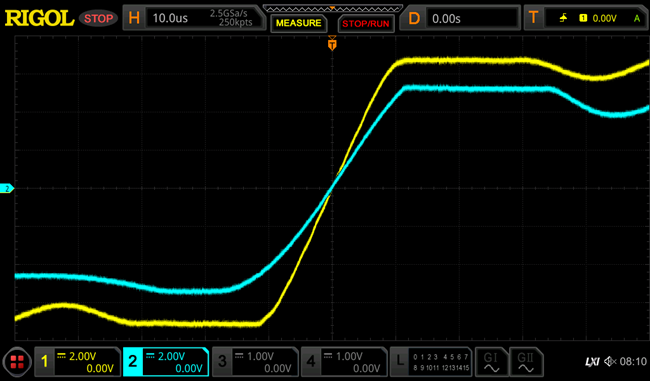
Figure 2. Rise Time: Input 0 dbFS, 1 kHz square wave. Yellow = Radius NX. Blue = Competitor’s signal processor. X axis is 10.0 µs/div, Y axis is 2.0 V/div.
Finally, a measurable answer to why Symetrix DSPs:
- Win shootouts.
- Are regularly deployed to tune high-performance audio systems.
- Are the choice of respected loudspeaker manufacturers to develop their tunings on.